
“Pot na Goričko” – Art Exhibition at Grad Castle
Special exhibition, on view until December 2027
Welcome to the Lemniscate – Grad Castle opening hours (read more).
The exhibition Pot na Goričko brings together the works of Slovenian painter Nikolaj Beer and Dutch artist Bram D’Hont, who has lived and worked in Goričko for many years. The title of the exhibition refers to Beer’s painting Pot na Goričko, created in 1986 and given to D’Hont forty years ago.
The exhibition juxtaposes two different relationships with Goričko – Beer’s return to the landscape of his origins and D’Hont’s presence in a landscape that has become his home. Connecting these two perspectives is an unusual, precisely defined path – the lemniscate, which becomes the central spatial and conceptual element of the exhibition.
Learn more about the history and concept of the exhibition, as well as the unusual path connecting the exhibited works.
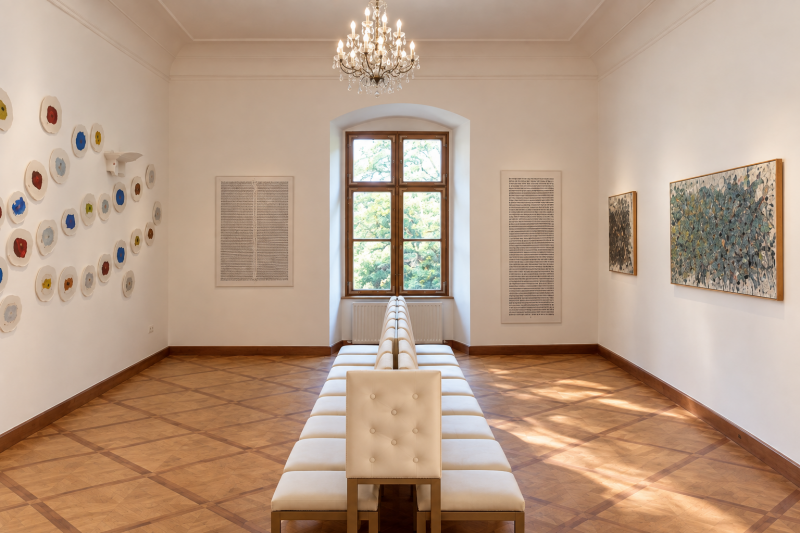
Pot na Goričko takes its title from a painting by Nikolaj Beer, which Bram D’Hont received as a gift forty years ago; it was painted in 1986. The title literally means the road to Goričko. Goričko is a cultural landscape of rolling hills, orchards, vineyards, fields, scattered farmsteads and forests. In Beer’s oeuvre, this area is a central motif: a landscape of origin, distance and return, which the artist depicts again and again. Beer was born in Križevci na Goričkem and later moved to Izlake in the Municipality of Zagorje ob Savi, where he lives and works. Art-historical interpretations of his motif Pot na Goričko emphasise precisely this never-completed movement of return and anticipation.
With D’Hont, the relationship is reversed. He comes from Zeeuws-Vlaanderen and lives in Prosečka Vas. For him, Goričko is not a lost landscape of origin to which he returns, but an environment he has actually entered and with which he has formed a connection. Nevertheless, the landscape of this region rarely appears directly in his painting. It functions primarily as a place of life, a source of material and a condition in which the work is created. The exhibition thus brings together two directions: Beer draws towards the landscape from a distance, while D’Hont, from his presence within this landscape, constructs a system that moves away from the visible environment.
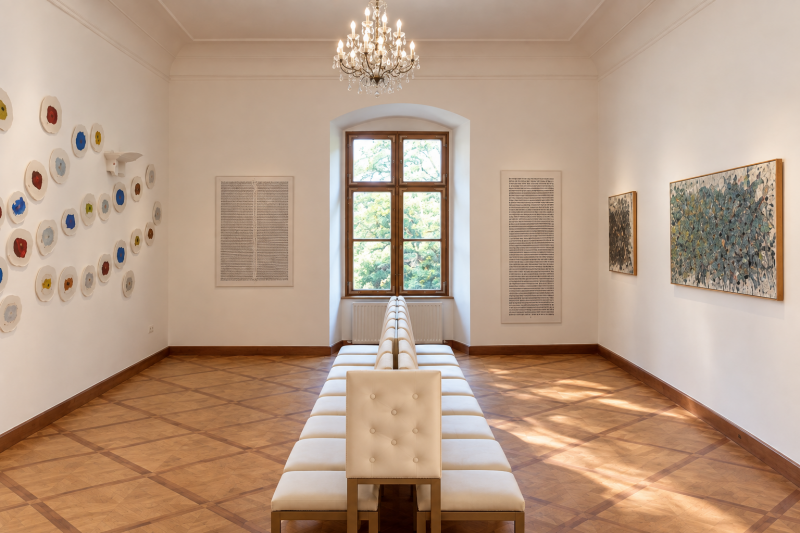
This contrast is not resolved. Instead, it is organised spatially. The installation is based on a closed path: the lemniscate. Fifty-two positions follow one another according to a single, precisely defined rule, until the sequence returns to its starting point. More on this later.
For now, it is enough to note that this path was not devised for this exhibition. It originates in Le moment Dansa, an algorithmic painting created in the 1980s. The property was already present in the work at that time – a rule has its properties even when nobody knows what they are – but it could only reveal itself when the same construction rule was applied to a digital image in 1996. There, after a certain number of steps, the image returned intact to its starting point, whereas otherwise it should have dissolved into noise. This paved the way for this path and, with it, for the work Pot na Goričko. The path takes its name from an unusual loop that could only be explained much later: the same traversal, carried out using a differently derived trajectory, requires exactly twice as many steps.
Two facts about this path are important for the exhibition; Section B describes them precisely. Halfway along the path, after twenty-six steps, we reach a position in which everything has been turned into its opposite, and this position coincides with the wall between the two galleries. In addition, there is a fifty-third position that is not part of the path at all: no number of steps leads to it.
Gallery I contains this final, most distant position. It is distant not because it requires many steps to reach, but because it cannot be reached in any number of steps – whereas the opposite position halfway along the path is entirely reachable. Here, it does not appear as an absence, but as a messenger, surrounded by historical paintings, documentation of the digital image operator and ephemeral images.
Gallery II contains the entire path: all the positions that are actually visited, rendered in plaster, in bits, as an independent work and in music. Opposite them is the work of another artist, which does not derive from this.
The dividing wall is not a neutral support. It is the hinge of the entire installation: on one side, memory and mirroring; on the other, execution in plaster, numbers and digital access. The visitor cannot see both sides at the same time. One side must be carried in memory to the other.
Where necessary, this text distinguishes between three types of statements: what is mathematically precise, what is historically documented, and what remains interpretation. Those wishing to examine the text from this perspective can first read the overview of the Levels of Validity, although it is intended as an aid to reading.